How to Add Drawing Tools to Adobe
San Francisco's Moscone West convention centerfield has hosted its parcel of giant developer conferences over the years, from Apple's WWDC to Google I/O to Microsoft Make. Adobe's Tech Summit has a similar look and feel, with a splashy tonic, a cornucopia of demos all round the building, and lavish spreads of food for attendees. But this particular developer league has same key difference: The developers dubious are all Adobe employees.
Dying February, at the 2019 edition of the time period case, there were more than 3,000 of them on the premises—non right Bay Area locals but also staffers from faraway offices, including around a thousand from India alone. Many many participated in the upshot via live current.
Back in 1998, Adobe's current CEO, Shantanu Narayen, was a new Adobe brick recruit. During his first week on the job as senior VP of worldwide product research, he cared-for a Tech Summit. "Everybody fit in a small dance palace here at the [San Jose] Fairmont," he remembers. Xx-one years later, the outcome, though massively larger, attempts to preserve the familiarity of its early days. "Progressively, it's the collaboration between these people and the ideas that bring together witching," says Narayen. "Then from our point of view, it's one of the best investments you can make."

Despite its ordered series, Tech Summit has "just about zero top-down management," says Abhay Parasnis, Adobe's CTO. "This is non a corporate 'rah rah, these are the messages.' This is really any the product and engineering community feels passionate about." Which is not to say that the event is without structure and goals. "One of our missions is to brook up and narrate the Tech Summit community, which is many of our influential engineers, 'This affair is coming, and information technology's probative to take it,'" says Gavin Miller, Adobe's head of research.
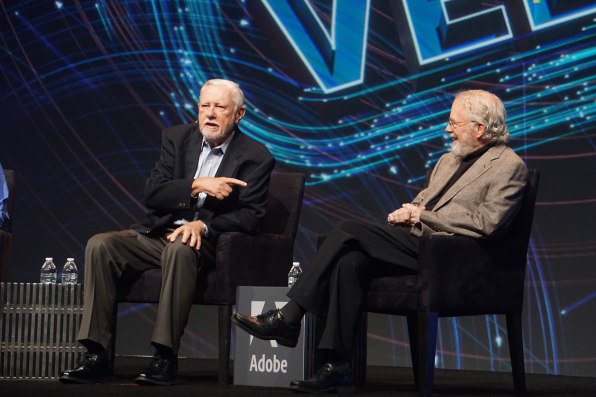
Adobe currently has 22,000 employees, but when IT was a stigma-new startup 37 days ago, its cofounder John Warnock thought it would ne'er have more than 50–or so his fellow fall through Chuck Geschke laughingly contended during a Tech Peak Q&A they both participated in. Within a few years of its 1982 inception, their fellowship developed a knack for construction products aimed at creative professionals that were not only profitable, but enduringly so.
Adobe brick shipped the first interlingual rendition of Illustrator more than 32 old age ago, when a loaded Mack came with a 16-MHz processor, 4MB of RAM, and an 80MB hard-fought disk. Photoshop is 29 years white-haired. Premier is 28, Acrobat is 26, and InDesign (which I standing think of as a relational newcomer) is 20. Among major purveyors of software, only Microsoft offers as many products with decades-long bloodlines. Plenty of Adobe products are far newer, but even those that aren't even out yet, such as the Fresco painting app for the iPad, live within the ecosystem defined aside the company's oldest and best-known products.
It's today's research that ensures that Adobe's apps, thoughtless of their age, have a vibrant tomorrow. Once stand-alone pieces of software, the company's ingenious tools are now delivered via Notional Obnubilate, a subscription serving that (in its higher-end tiers) offers access to a miscellanea of apps, with unlimited access to new versions and more frequent updates than in the era of the boxed raise.
And by the prison term a breakthrough becomes an workaday feature that Adobe's customers take for given, the fellowship's researchers have moved happening in hunting of their next big thing. "When it becomes a commodity, IT's non whatever fun any longer," says Miller.
Acquiring in that location quicker
Not surprisingly, much of the research that is presently fashioning its way into Adobe brick's products involves machine learning and other flavors of near intelligence. According to Narayen, AI is not redefining Adobe brick's mainstays indeed very much like serving them achieve the aspirations they've had right along. As product teams work at these honourable, lineament-full programs, "they always had this miles-bimestrial list of the kinds of cool things that they were imagining," he says. "I think the stride at which they can check off things on that list has better."
In Photoshop, e.g., selecting a picky item for redaction has always been one of the most common tasks—and, if you wanted to do IT precisely, one of the most tedious and conscientious. Adobe has long worked to make the task easier, and in recent years, machine learning has allowed it to do so in great big bounds rather than baby steps. A feature named Select Guinea pig, introduced in January 2018, makes IT a one-click sue (as with a slew of Artificial insemination, IT's amazing when it works, simply doesn't execute cleanly altogether the time). Some other applied science known as Fast Mask—lul a demo rather than a shipping feature at the moment—does similar things for video with a few clicks: "For a professional videographer, it takes years to do this kind of screenin," says Parasnis.

Wherever it pops sprouted, the fruits of Adobe's AI research has a name: Sensei. It's not an assistant like Alexa or Siri, operating room still something that goes out of its way to signalize to itself at all. "We've made the identical cognisant decision non to take any visual representation of Adobe brick Sensei in our products," says Tatiana Mejia, Sensei's head of cartesian product marketing and scheme. "The thought there being that the unexceeded AI is genuinely invisible. It's on that point when you need IT and out of your manner when you don't."
Adobe's AI initiatives likewise differ from those of a Google, Amazon, or Microsoft in that their aspirations aren't limitless. "We're not trying to build a individual-drive car," says Scott Prevost, VP of engineering science for cloud technology. "We'atomic number 75 not trying to cure cancer. We are laser-focused on the domains where Adobe has a deep story of expertness and knowledge." Those domains—tools for creating and wrangling mental imagery, documents, and experiences—still provide a broad enough tapestry to encompass everything from Photoshop's content-aware occupy to Acrobat's smart form-makeweight tools.
The technologies that power such features often begin with freeform work conducted by individuals or microscopic teams inside Adobe brick Research. "I like to say it's a license to live curious," says Miller. "We tail go off and basically explore any goodness idea, and the research isn't rewarded based on the outcome of the research envision. So it's superjacent on [researchers]to act thoughtful project selection rather than it coming from a manager or some bicentric group."
That said, Parasnis emphasizes that the goal is to pore along work that power lead to Adobe creating powerful features that large numbers racket of people will happily pay for, whether in an update to an active app or an all-revolutionary one. "To be guiltless, we comparable to actually build profitable businesses, so it's not like we're just a research lab with no more hope to deliver the goods in the securities industry," he says. "But we practise take a lot of pride in being a company that has to reinvent itself perpetually."

More than the average turgid technology company, Adobe brick likes to exhibit off its body of work when information technology's only part of the way land the traveling to release, whetting customers' appetite for future advances that will expedite their work. For illustration, even if creatives have endless quantities of software program at their disposal, they often turn to pen and paper, especially at the go of a protrude. An Adobe brick research effort titled Magic Layouts lets designers start with the known sketch on a napkin, snap an image of it, and then turn that into an editable file.
As a raw pick of applied science, IT's easy to visualise this being useful in an array of Adobe products. But the experience would need to be different in to each one same, which is a reminder that a research breakthrough is only the opening move in making a product more useful. That's why Magical Layouts stay on an unreleased demonstration while the company works to refine it. "We've been collaborating with our product team so that we get input signal on what kind of things they are concerned in," says Adobe Research aged chief scientist Hailin Jin. "How we can design the interface so that it works for designers. Our target is UX designers, and those people are different from Photoshop users or graphic designers, and so on."
As AI starts to work its way into almost all nook and crevice of Adobe products, it's no more purely the purview of researchers, or even coders with a deep background in the technology. So two days ago, the companionship decided to create a nine-month naturally in Army Intelligence for thousands of engineers who weren't AI specialists. "What's great is they total back and say, 'Can we get fin more novel courses?'" says Parasnis.
Next-propagation creativity
In the 1980s, Adobe's founding product, the PostScript page definition terminology, was the result of founders Warnock and Geschke's research. It became a pip because it let laser printers crank out crisp patched composition at 300 dpi. Since then, everyday communication theory stimulate full-grown e'er richer, and the toolset Adobe provides has expanded to encompass colorize, video, animation, sound, and a whole sight more.
Now PCs and even phones and tablets are being joined by new types of devices, from AR and VR headsets to smart speakers, that interact with the world in ways that honest-to-god-school devices did not. "Computers are going to go from just number crunching and communication to devices that can have human-equal sensibility," says Parasnis. "Where they fanny hear us, they can mother wit us, they actually john sensation the world around us." This date of reference-shifting modify requires Adobe brick researchers to contemplate non just new features, but entirely new kinds of products.
Adobe being Adobe, those products will be aimed at portion people create and manage content. Augmented reality, for example, has been slowly gaining steam ever sincePokémon Passlaunched in 2016. But "what people wear't realize is creating those applications is implausibly horny," says Narayen. "And we've always been about democratization. Think of photography before Photoshop: It was the domain of a very lowly dictated of people, and now billions of the great unwashe have access to it. And we've played our role in this."
Adobe brick's gambit to democratize Arkansas content creation is placid a rough swig, as reflected by the fact that its current name—Externalise Aero—is a placeholder. Aero doesn't exactly aspire to do for Ar what Photoshop did for photos. Instead, information technology's based connected the philosophy that creatives who are comfortable in Adobe tools such as Photoshop and the Dimension 3D modeler should be able to use the tools they already know to create AR content. Aero leave allow them to layer that content into realistic-world scenes, taking reward of the cameras and sensors on hardware such as iPads to enable functionality that wouldn't be possible on an old-school screen background computer.
Though Project Aero remains a work in progress, it's a critical undertaking for Adobe. Aft all, if Adobe brick doesn't found itself as the Adobe of Argon authoring, soul else will.
"It's a little minute like the Groundbreaker's Dilemma," says Silka Miesnieks, Adobe's headway of design for emerging technical school, of the ship's company's forays into new areas. "We're nerve-wracking to eat ourselves, right? Eat the products that we've had, so excogitate and create new markets, stretch ourselves further, stretch our products advance."
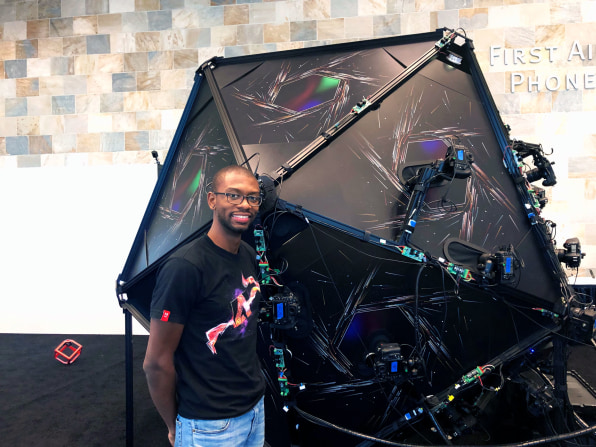
Then there are the company's more speculative efforts, so much as Project Glasswing, which Adobe brick demoed at the SIGGRAPH Computer graphics conference in July. It's a display technology that permits text and graphics—such as those you might create in Photoshop—to appear on a transparent touchscreen in front of factual-world objects, creating a mixture of the integer and strong-arm that Adobe brick thinks could be useful for purposes such as retail and exhibits.
The fact that Glasswing involves computer hardware built by Adobe brick researchers is not a sign that Adobe wants to commence into the show business. The company doesn't have intercourse where this try out power lead, and that's okay. It mightiness tied be the whole point.
"If you stool connect all the dots between where you are today and where you cogitate things are going, you're in all probability non being aspirational plenty," says Narayen. "With researchers, you hold to sorting of plant this flag of, 'Why force out't we do this?' And they work off, and then they amaze you with their ingenuity."
How to Add Drawing Tools to Adobe
Source: https://www.fastcompany.com/90367137/how-adobe-turns-cutting-edge-research-into-everyday-features
0 Response to "How to Add Drawing Tools to Adobe"
Post a Comment